
For candidates
Invited to a Hirevalu Interview? Here's How to Do Well
What a Hirevalu AI interview is, how to set up your camera and audio, and how to answer clearly and confidently — a practical guide for candidates.

You’ve received an invitation to a Hirevalu interview and you’re wondering what that actually means. Is it a real interview? Is anyone watching? What happens if you say the wrong thing?
Short answer: it’s a normal screening interview, conducted by an AI interviewer instead of a recruiter’s calendar. You talk, it listens, it asks follow-up questions based on what you said. Then a human at the company reads the result and decides what happens next.
This guide covers what to expect and how to give yourself the best shot.
What is a Hirevalu interview?
It’s a conversational video interview run by an AI agent. Not a form, not a one-way “record yourself answering these five questions” test.
A few things worth knowing:
- It’s a conversation. The agent listens to your answers and asks follow-up questions based on what you actually said, the same way a recruiter would.
- Everyone gets the same process. The same core questions and the same scoring criteria are applied to every candidate for the role. Nobody gets an easier interview because they were scheduled on a good day.
- It’s usually 10 to 30 minutes, depending on the role.
- You choose when to take it. No back-and-forth scheduling. Take it when you’re ready, within the window in your invitation.
- A human makes the decision. The system produces a report with your answers and a score against the role’s criteria. It does not reject anyone. A person at the company reads it.
That last point matters, so it’s worth repeating: nothing about your application is decided automatically.
Before you start
Five minutes of setup prevents most of what goes wrong.
Find a quiet room where you’ll be alone. Not a café, not a shared living room with a TV on. Background noise makes it harder for the agent to hear you clearly, and other voices in the room can be misread as someone helping you.
Check your connection. A stable connection matters more than a fast one. If your Wi-Fi is unreliable, sit closer to the router or use a wired connection.
Test your camera and microphone before you begin. Your browser will ask for permission — allow both. If you’ve previously blocked them for the site, you’ll need to re-enable them in your browser settings.
Use a laptop or desktop if you can. Phones work, but a propped-up laptop is steadier and easier to speak to naturally.
Close everything else. Other tabs, notifications, and background apps compete for bandwidth and attention.
Appearing well on camera
You’re not being judged on your appearance. But being clearly visible helps the conversation feel natural, and it’s what a hiring manager will see if they watch the recording later.
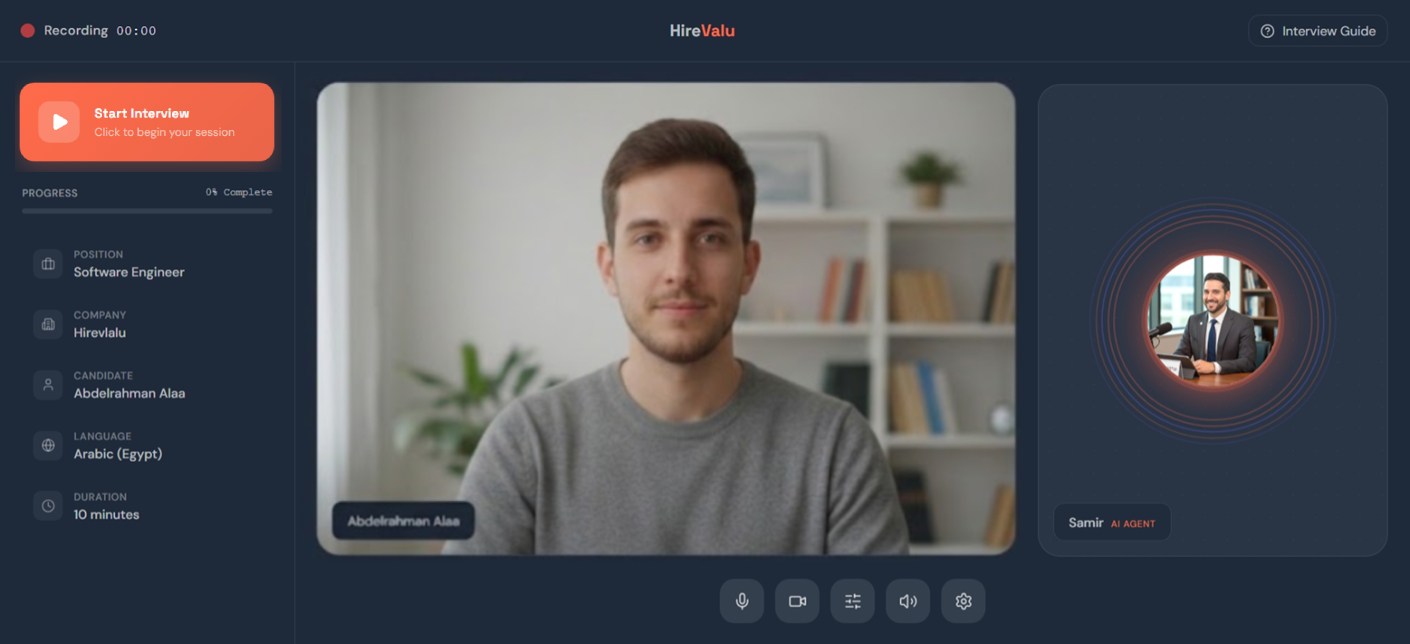
Get the framing right. Your head and the top of your shoulders should fill the frame, with a little space above your head. Not a close-up of your forehead, not a distant figure across the room.
Raise the camera to eye level. A laptop on a desk points up at you from below, which is unflattering for everyone. A few books under the laptop fixes it.
Put the light in front of you, not behind. A window or lamp behind you turns you into a silhouette. Facing a window is the easiest good lighting there is.
Keep the background plain and tidy. A blank wall is perfect. Nothing needs to be impressive — just not distracting.
Look at the camera, not at yourself. It’s natural to watch your own video preview. Looking at the lens reads as eye contact.
Speak clearly and at a good volume
This is the single most common thing that goes wrong, and it’s entirely fixable.
Speak up. A little louder than feels normal in an empty room. Quiet, mumbled answers are harder to transcribe accurately, and anything the system can’t hear properly can’t be scored properly.
Slow down slightly. Nerves speed everyone up. Deliberately slowing your pace makes you easier to understand and gives you time to think.
Finish your sentences. Trailing off at the end of an answer is common when you’re unsure. Land the point.
Don’t worry about your accent. Communication is scored on clarity and structure, not on accent or on sounding like a native speaker. If English (or the interview language) isn’t your first language, take your time — that is completely normal and expected.
If you need a moment to think, it’s fine to say so out loud: “Let me think about that for a second.” That’s exactly what you’d do with a human interviewer.
Listen carefully and let the agent finish
The agent asks follow-up questions based on your answers, which means the conversation only works if both sides get to finish.
Let the question finish before you start answering. Jumping in early means you may answer a question that wasn’t asked. The agent often adds important detail in the second half of a question.
Don’t talk over the agent. If it’s still speaking, wait. Interrupting repeatedly makes the conversation harder to follow and can cut your own answer short.
Pause briefly before answering. One or two seconds. It makes sure the question is finished and it makes your answer sound more considered.
If you didn’t understand, say so. Ask for the question to be repeated or clarified. That’s a reasonable thing to do and it’s better than guessing.
Answer with confidence
Confidence here doesn’t mean performing. It means answering like someone who knows what they did.
Be specific. “I improved our deployment process” says very little. “Deployments took about two hours and broke often, so I moved us to automated releases and got it to fifteen minutes” is an answer someone can evaluate.
Use real examples. Talk about work you actually did. Vague, general answers score poorly because there’s nothing concrete to assess.
Structure longer answers. Situation, what you did, what happened. You don’t need a formula, but a beginning, middle and end helps enormously.
Give answers room to breathe. One-sentence answers leave the agent nothing to follow up on. Aim for a solid paragraph on substantive questions.
Don’t claim things you can’t back up. Follow-up questions probe what you say. Overstating experience tends to unravel two questions later — being honest about what you haven’t done is far stronger than being caught out.
Don’t read from a script. Prepared notes are fine as a reminder. Reading answers word for word sounds flat, and reading aloud can be flagged for review.
What happens afterwards
When you finish, your interview is turned into a report for the hiring team: your answers, how you performed on the role’s criteria, and a recommendation.
- A person reviews it. Your report goes to a recruiter or hiring manager.
- The company decides the timeline. Hirevalu doesn’t control when you hear back — that’s the employer’s process, exactly as with any other interview.
- Finish in one sitting if you can. An incomplete interview is marked as incomplete and can’t be compared fairly against candidates who finished.
Common questions
Is a real person watching me live? No. The interview is conducted by the AI agent. The recording and transcript are reviewed afterwards by the hiring team.
Can I retake it? That’s up to the employer. If something went genuinely wrong — your connection dropped, your microphone failed — contact the company’s recruiter and explain.
What if I make a mistake mid-answer? Just correct yourself and continue, exactly as you would with a person. “Sorry, I mean 2023, not 2022” is completely fine.
Do I need to dress formally? Dress as you would for a video call with that employer. Smart-casual is a safe default for most roles.
Can someone else be in the room to help? No. Interviews are monitored for integrity, and another person answering or prompting can get the session flagged. Take it alone.
What if I’m nervous? Very normal. Take a breath before you start, sit up, and remember that the questions are about work you’ve already done. Nobody expects perfect delivery.
The short version: quiet room, camera at eye level with light in front of you, speak up a little more than feels natural, let the agent finish, and answer with specific examples from real work. Do those five things and you’ll come across the way you should.
Good luck.